Mimic Robotics
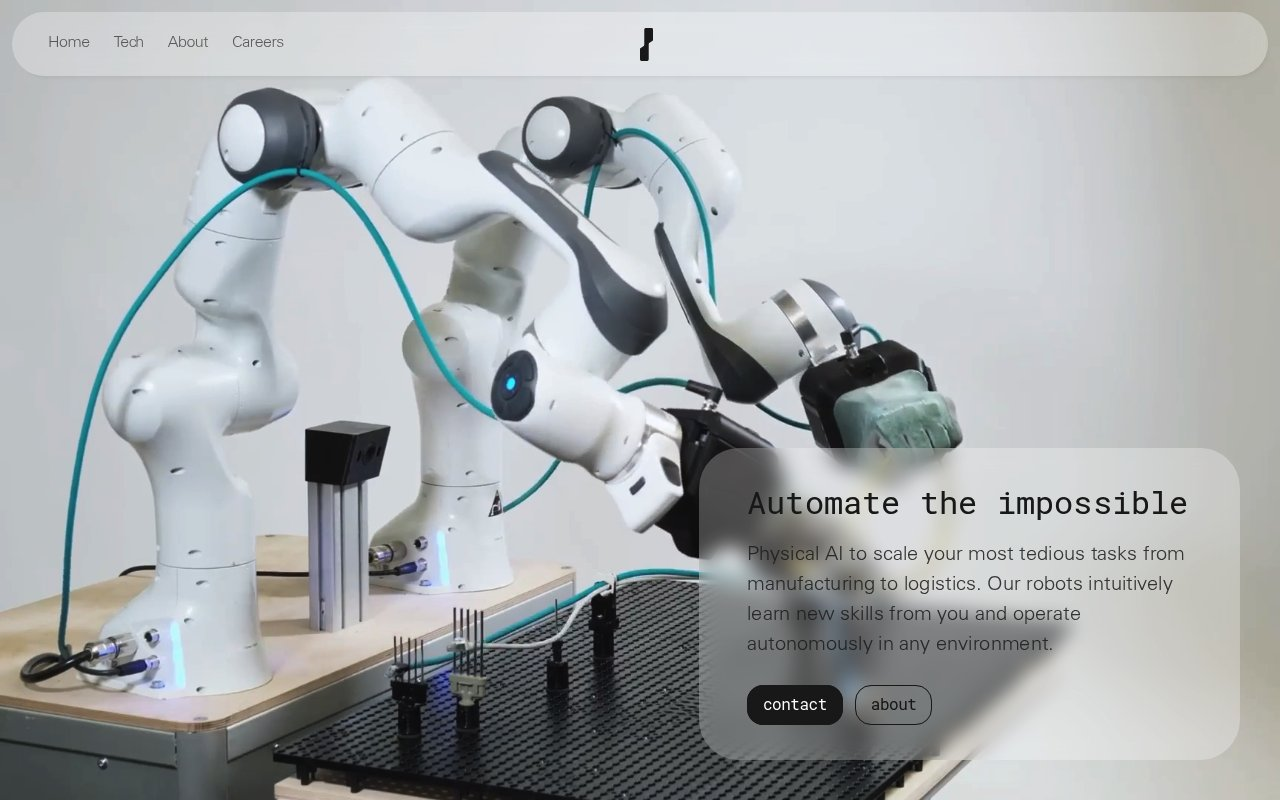
Mimic Robotics builds physical AI robots that intuitively learn new skills from humans to autonomously perform tedious tasks in manufacturing and logistics.
Classification
Profile
Funding
Funding details not yet available.
General-purpose physical AI robots that intuitively learn new skills from humans to autonomously automate tedious tasks in manufacturing and logistics.
Enterprises in manufacturing and logistics industries seeking to automate complex physical tasks.
- Hardware sales - robotic hand units, wearable data-capture kits, and optional gripper accessories
- Direct enterprise sales force (pilot‑to‑scale approach).
- Strategic OEM partnerships with robot‑arm manufacturers (e.g., Universal Robots, KUKA) to bundle the hand as a plug‑in module.
- System‑integrator network for turnkey deployments.
- Industry events, webinars, and the company website for lead generation.
- Digital outreach on LinkedIn, Twitter, and niche forums (e.g., r/robotics, Manufacturing Network groups).
ETH AI Center - research collaboration, talent pipeline, and joint IP · Robot-arm OEMs (e.g., Universal Robots) - mechanical integration and distribution channels · Sensor manufacturers - supply of IMUs, force-torque sensors for wearables
R&D for frontier physical AI technology and building a specialized team in Europe.
Proprietary physical AI technology, human-in-the-loop learning algorithms, and a specialized European engineering team.
Developing general-purpose autonomy technology and training robots to learn skills intuitively from human operators.
High-touch consulting during pilot phases - on-site engineers co-design the task · Subscription-based AI model updates and remote monitoring (SaaS layer) · Dedicated technical support & training for in-house operators
Competes in the physical AI space by offering robots that learn from humans rather than requiring rigid pre-programming for specific environments.
Tedious physical tasks in manufacturing and logistics that are difficult to automate with traditional rigid robotics.
- Channel diversification - Negotiate OEM bundling agreements with at least two major robot-arm manufacturers to embed the hand as a standa
First-mover advantage in “Physical-AI” for dexterous tasks can lock in customers via proprietary datasets and model fine-tuning · Scaling manufacturing of the hand is a critical bottleneck; strategic OEM partnerships can mitigate capacity constraints · A SaaS layer creates predictable recurring revenue, improving valuation and enabling reinvestment
- Funding validation - A $16 M seed round in late 2025 (SiliconAngle, 2025) demonstrates strong investor confidence in the technology and m
No investors recorded yet.